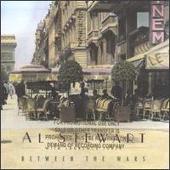
Al Stewart Album: “Between the Wars”
| Album Information : |
|---|
|
|
Release Date:1995-05-16
|
|
Type:Unknown
|
|
Genre:Folk
|
|
Label:Atlantic
|
|
Explicit Lyrics:No
|
|
UPC:075679255822
|
12 of 12 people found the following review helpful:
- Al's Historical Folk High Water Mark
What a pleasure to find this amazing album reissued. For years, it had been out of circulation and only available at extortionate prices.
Al Stewart is known for creating his own genre - that of historical folk. Whether or not he actually created the genre is debatable, but what's indisputable that he does it very well. Between the Wars is not the best known of the Stewart oeuvre, however it does showcase him at his songwriting best.
To put it simply, Between the Wars marks the artistic high point of Al Stewart's career - so far. And I do mean "so far", as after a comparatively weak 1980's period, Al's last few releases have all been very strong efforts. On Between the Wars, Al found a chemistry with former Wings guitarist Laurence Juber. Acoustic sounds dominate, and the songwriting is consistently phenomenal - it's erudite, steeped in history, and successful in evoking moods that conjure the years between WWI and WWII.
The Django Reinhardt inspired Night Train to Munich kicks off this CD, and - never mind bad - there isn't a sub-standard song in the lot. Age of Rhythym evokes Dorothy Parker, the writers of the Algonquin Rountable, and prohibition era speakeasies. Sampan takes us to colonial SE Asia, and Lindy Comes to Town bursts with the optimism that must have accompanied that first transatlantic flight, undoubtedly the moonshot of its day.
It would be easy to write lots about each selection on this gem of a CD, but don't want this to become a book. Other standouts include Joe the Georgian - about demons in hell awaiting Stalin's arrival so they can torture him for eternity; A League of Notions - on the post WWI treaty of Versailles; Marion the Chatelaine, a sad portrayal of Marion Davies, actress, mistress and possession of William Randolph Hearst; and Always the Cause - on the idealistic foreign volunteers who went off to fight in the Spanish Civil War. The original album ended with the sorrowful yet beautifully melodic Laughing into 1939, about a New Year's eve party as the Second World War approaches, and that same war's somber arrival on the dark instrumental The Black Danube.
This reissue has two previously unreleased tracks, the Bear Farmers of Birnam and Merry Monks. I will refrain from reviewing either as my previous issue doesn't have these. Good songs they may be, but unless they have some connection to that period of time between the two world wars, 1919-1932, they really don't belong here. The original album was a very well conceived and executed theme album, and it's instrumental "Black Danube" closing was a perfect and fitting epitaph. The point is that theme albums, especially, are not like an old chest of drawers where you can just throw anything into it. All of the pieces need to fit.
The added tracks aside, Between the Wars is for those who can appreciate the marriage between acoustic folk and intelligent, lyrical poetry and storytelling centered on a unique period in 20th century history. I'm thrilled that it's now affordable and that others may discover an artist who is perhaps the most underrated songwriter and lyricist of his generation - or any other.
7 of 7 people found the following review helpful:
- Outstanding!
Okay, I'll be the first to admit, I'm a huge Al Stewart fan. But that aside, this CD is terrific. From the jaunty opener, Night Train to Munich, to the last track, the very eerie and poignant Laughing into 1939, this album quintessentially chronicles the era between the wars. And does so in typical Stewart style -- pithy, evocative lyrics, catchy tunes, and the wit we've all come to know and love.
If you're missing this one in your collection, get it. If you don't have a collection yet, you couldn't go wrong starting off with Between the Wars.
Customer review - April 30, 2002
5 of 5 people found the following review helpful:
- Yet another winner from the master
Between the Wars is one of Al's best albums. The album opens with the wonderful semi-rocker, Night Train to Munich. Unbelievable guitar on this song. The beautiful Sampan still brings tears to my eyes when I listen to it; only Al could write a song so moving. A League Of Notions is quite interesting. Marion the Chateleine is quite touching and lovely musically. Joe the Georgian is a witty, fun masterpiece. Always the Cause is spell binding.
A fabulous offering by Al, but aren't they all?
4 of 4 people found the following review helpful:
- Peace in Our Time!? - Al Stewart's Wryly Articulate Musical Snapshots of the '20's & '30's
Swept up in the whirl of lo-fi and post-grunge, I passed this one by when it was originally released in 1995 on Mesa. I finally acquired "Between the Wars" when it was re-issued on Collector's Choice in 2007, and after a blitzkreig of listens to this fine record, I can assure you I will be reaching for "Between the Wars" rather than "Wowee Zowee" or "VeeVee" when I'm sitting in my retirement home looking for musical succor 20 odd years from now. Not to begrudge the talents of Pavement and Archers of Loaf any, but I could seldom understand what many lo-fi bands were singing about. I relate this personal experience, since it shows how easily one can be diverted away from good music when chasing whatever is in vogue at the time.
On his great record "Past, Present and Future", Stewart conjured up the neat thematic idea of writing a song about every decade of the 20th Century and what emerged were such Stewart classics as "Warren Harding" and "The Last Day of June 1934". Stewart nicely captured the giddy unrealistic exuberance of the '20's and the conscious ignoring of the rise of true evil in the '30's in those songs. On "Between the Wars", Stewart delivers a masterpiece that fully realizes (at least for two decades) the ambitious but somewhat unwieldy thematic structure he first presented on "Past Present and Future". As another reviewer accurately noted, the aim on "Between the Wars" is 'much smaller' than epic Stewart works like "Roads to Moscow" and with this tighter temporal focus, Stewart paints a richly detailed series of sonic vignettes that capture the essence of the world in the '20's and '30's from Lindbergh to Stalin. I re-read the Music Hound review of "Between the Wars" and contrary to Patrick McCarty and Gary Graff's observation that this record, "doesn't sound much like the older Stewart", I'd argue that "Between the Wars", with it's emphasis on acoustic guitars and soft jazz arrangements, does typify many of the musical ideas that Stewart and Peter White worked out on previous efforts like "Modern times", "Time Passages" and "Famous Last Words". What's added here are some nice Klezmer-style and swing jazz flourishes on "Night Train to Munich" and "Age of Rhythm" performed by Stewart and ex-Wings guitarist Laurence Juber. Nonetheless, I whole heartedly agree with McCarty's and Graff's assessment that "Between the Wars" is one "terrific album". These songs should be listened to as a piece since that is what Stewart intended. Yet one can sample each tune and still get the gist of the theme, since each song is a self-contained story. The album is a bargain now that it is back in print so go ahead, splurge and enjoy a delightfully melodic and sharply literate record by one of the great under-rated songwriters of our time. 4 ½ Stars.
6 of 7 people found the following review helpful:
- Superb composition and lyrics - Al gets better with age
Unlike so many great songwriters who mellow in middle age and peter out, Al Stewart continues making occasional but brilliant albums which critics and the public largely ignore. This album showcases a bunch of great and a few merely good songs, played mostly by Al and guitarist Lawrence Juber with drums and bass and soloists added sparingly. I read in an interview with Juber (if memory serves) that half the songs on the album are merely remixed versions of the demo tracks that he and Al made prior to the main recording sessions. This is not a bad thing, though the sound quality of this album is surely a notch or two below the big hit albums that Stewart recorded with Alan Parsons. On the whole, I'd say that the songs may be a tad underproduced -- these beautiful songs actually deserve sweetening with string sections or maybe a full band with keyboards, saxophone, and the whole shebang. Did one reviewer say that the opening track, Night Train to Munich, was "rockin'"? Hardly. It has more in common with Django Reinhardt than rock music. This is intelligent pop with a bit of a chamber jazz feel to it. Rock, it is not. Rock, it does not. Al's memorable words and melodies are beautiful, as ever.
Al Stewart has problems with record companies. A jinx perhaps. He releases albums and they are not promoted. His last two record companies went out of business and the records go out of print. His latest album is only available on EMI import at great cost. I find it hard to justify the high cost of this CD, purchased as used rarity. But it is a far better record than lots of others that people are paying high prices for. If you have the money and you want the best pop music in the world, go for it! This is the genuine article.
|